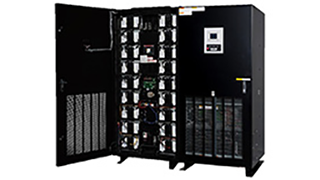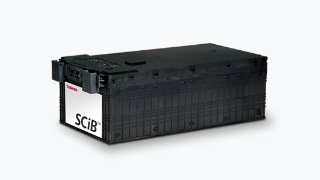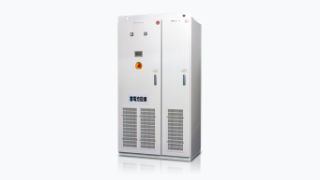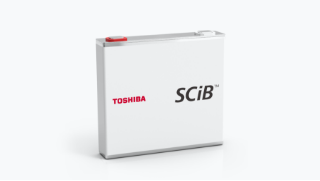


For a data-center or industrial UPS, Toshiba's SCiB™ — a rechargeable lithium-ion battery that uses lithium titanium oxide (LTO) for the anode — is used in place of lead-acid batteries: a UPS built with SCiB™ can be smaller and lighter than a conventional lead-acid UPS, and its long life reduces battery replacement costs. Toshiba's SCiB™ usage blog for data-center UPS reports that battery capacity can be cut to one third or less, and the space to about half. The modules listed for UPS are Type3-23 (45 Ah, DC 27.6 V, W190 × D361 × H125 mm, approx. 15 kg) and Type3-20 (40 Ah, DC 27.6 V).
Small, light UPS systems for efficient space utilization
In line with stable corporate business activities continuation and spread of data centers, it is becoming essential to secure power supply in the event of a power failure. Uninterruptible power supply (UPS) systems equipped with SCiB™ provide a long life, safe and stable power supply even for space-constrained facilities.
Increase in system
availability
Reduction in waste
Safe operations
Improve space utilization and reduce battery replacement costs
Since conventional UPS systems using lead-acid batteries are heavy and have a large footprint, there are restrictions on the place of installation. UPS systems using SCiB™ can be designed to be smaller and lighter than the conventional UPS systems and therefore provide greater flexibility in floor layout. In addition, SCiB™ helps reduce battery replacement costs because of its long life and high reliability.